



Relaxing music for dogs: benefits and how to use it and effective treatment
Friday, June 27th, 2026
Care and advice
Discover how relaxing music for dogs reduces stress, improves their behavior, and when to use it. Complete guide with practical tips.
The environment in which our faithful companions live is full of auditory stimuli. Often, the hustle and bustle of the city, traffic, construction, or unexpected noises can disturb their peace. As part of comprehensive care for their well-being, seeking tools to help calm the furry ones at home is essential. In this regard, relaxing music for dogs has become an excellent therapeutic resource, supported by ethology studies, to reduce anxiety levels and improve their quality of life.
In this article, we analyze how melodies influence the canine body, which frequencies are most suitable, and how you can introduce these sound stimuli into their daily routine to create an environment of absolute serenity.
Relaxing music for dogs: benefits for your pet
Introducing specific sound elements into the home goes far beyond simply playing background entertainment. The right sounds have a direct impact on animals' nervous systems, helping to balance their vital signs during critical moments. If you are planning a getaway with your companion and want them to start associating moments of calm with their carrier or room before traveling, we invite you to check out the options at our Dog Friendly Travel Agency to design a perfect, stress-free adventure.

Why does music work on dogs?
How dogs perceive sounds
The sense of hearing in canines is infinitely more sensitive than ours. They can register ultrasonic frequencies that are completely imperceptible to the human ear (up to 45,000 Hz compared to our 20,000 Hz) and pick up noises from four times the distance. This acuity means that a sound that seems moderate to us can be invasive or annoying to them, hence the importance of carefully selecting what we play at home.
Differences between human acoustics and music for animals
Not all music that we humans enjoy has a positive effect on animals. While we pay attention to lyrics, complex progressions, or changes in rhythm, effective music for animals is based on simplicity, regularity of tempo, and the absence of harsh sounds. A fast rhythm or a very high-pitched wind instrument can trigger their alert state instead of calming it.
What types of stimuli relax canines the most
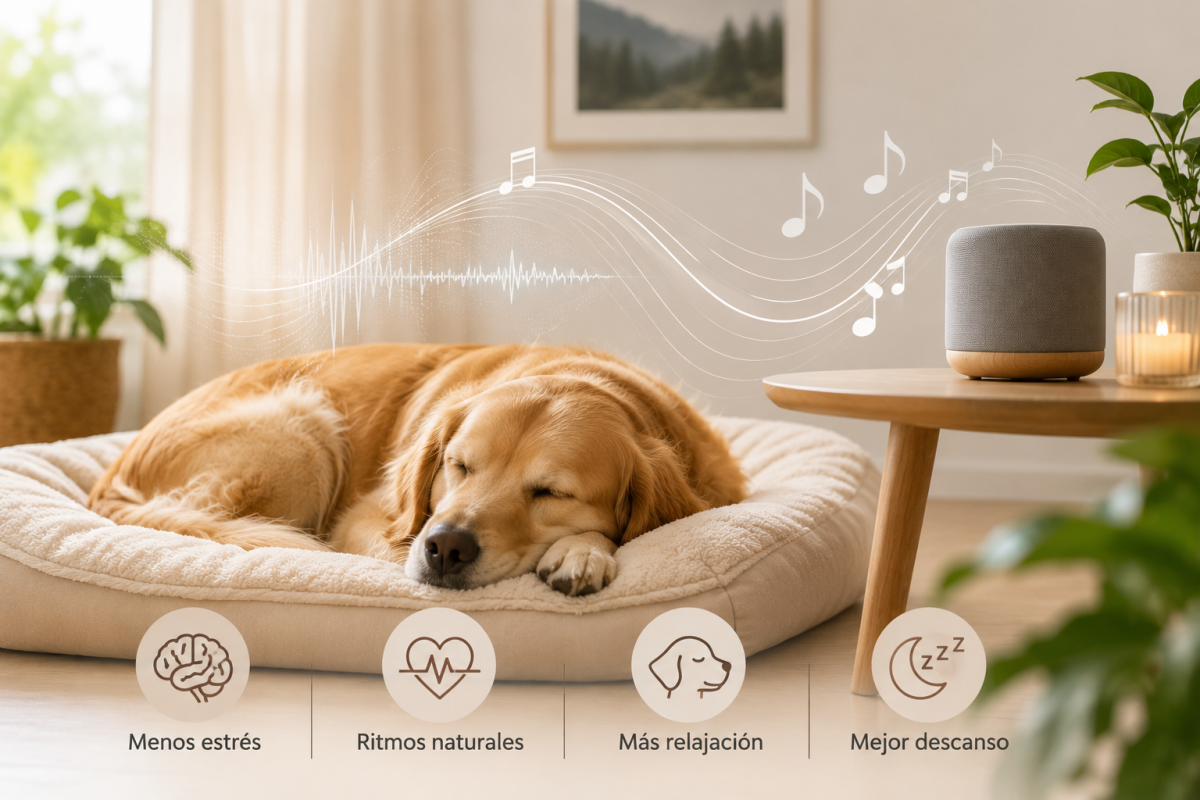
The patterns that work best are those that mimic natural biological rhythms, such as the maternal heartbeat at rest. Slow tempos, sustained notes, and predictable structures induce an almost immediate state of physical and mental relaxation, decreasing brain activity associated with vigilance.
Benefits of relaxing music for dogs
Reduces anxiety and stress
The main benefit is the reduction of cortisol levels (the stress hormone) in the body. Exposure to stable melodies promotes the release of endorphins and serotonin, helping the animal transition from a state of reactivity to one of organic calm.
Helps with acoustic phobia crises (storms, fireworks)
Days of intense storms or holidays with fireworks are real nightmares for many pets. Sounds for dogs designed to mitigate panic act as an acoustic screen (masking), cushioning the impact of external explosions and offering a safe auditory refuge inside the home.
Improves rest and sleep
Just as it happens to us, a harmonious sound environment helps achieve deeper, more restorative sleep. This is especially valuable for puppies adapting to their new home or for senior dogs suffering from insomnia or nighttime disorientation.
Facilitates habituation when left alone
For dogs that experience unease when their owners leave for work, the background music mitigates the 'sudden silence' of the house, reducing destructive behaviors, frustration barking, or compulsive pacing near the door.
What type of music is best for dogs
Classical music and its proven effects
Various ethological studies in shelters have shown that classical music (especially composers like Chopin, Mozart, or Bach) significantly reduces barking and slows down the animals' heart rate. However, compositions with large orchestrations or sudden volume changes (such as some pieces by Beethoven or Wagner) should be avoided, prioritizing solo piano or string compositions.
Ambient sounds: nature, white noise, and soft frequencies
White noise and pink noise are excellent for masking annoying neighborhood or street noises. Likewise, tracks that incorporate background sounds of light rain, the murmur of wind through trees, or gentle ocean waves are very evocative and soothing for them, as long as they do not include barks from other animals or excessively shrill bird songs.
Specific compositions for the veterinary sector
Nowadays, there are bioacoustics projects that create exclusive compositions for pets. These works modify traditional tuning, adapt the frequency spectrum to their hearing range, and use instruments with sweet timbres to ensure optimal assimilation without causing auditory fatigue.
When to use relaxing music for dogs
During the family's absence
It is the star tool for cushioning separation anxiety. Ideally, turn on the equipment a few minutes before leaving home, integrating it naturally into the environment so that it does not become a predictive signal that you are about to leave.
During periods of transition or routine disruptions
Moves, the arrival of unfamiliar visitors at home, or car trips are situations that break their comfort zone. Using these melodies helps soften the emotional impact of change, maintaining a familiar constant in their environment.
As a prelude to sleep hours
Playing a soft acoustic background during the last hour of the afternoon, coinciding with the dimming of artificial light, helps the animal's body prepare for nighttime rest, synchronizing with the house's circadian rhythms.
How to use music correctly
Moderate volume and dosage
The volume should always be low or medium-low; remember that they hear much better than we do. Additionally, it is not advisable to leave music playing 24 hours a day. The animal's brain needs periods of absolute silence to rest from any sensory processing; otherwise, it will become accustomed to the stimulus and it will lose its therapeutic effect.
Avoiding interferences that could startle the animal
If you leave a playlist playing, make sure to use platforms or versions that do not introduce sudden advertisements, as the shrill voices of commercials or advertising jingles would immediately ruin the calming effect.
Establishing a positive association
Music does not work miracles on its own if you play it for the first time during a full-blown panic attack. First, you should play it in moments when the dog is already calm (eating a long-lasting snack, receiving affection, or resting with you), so that its brain associates that specific melody with an emotional state of absolute security.
Platforms and available options
-
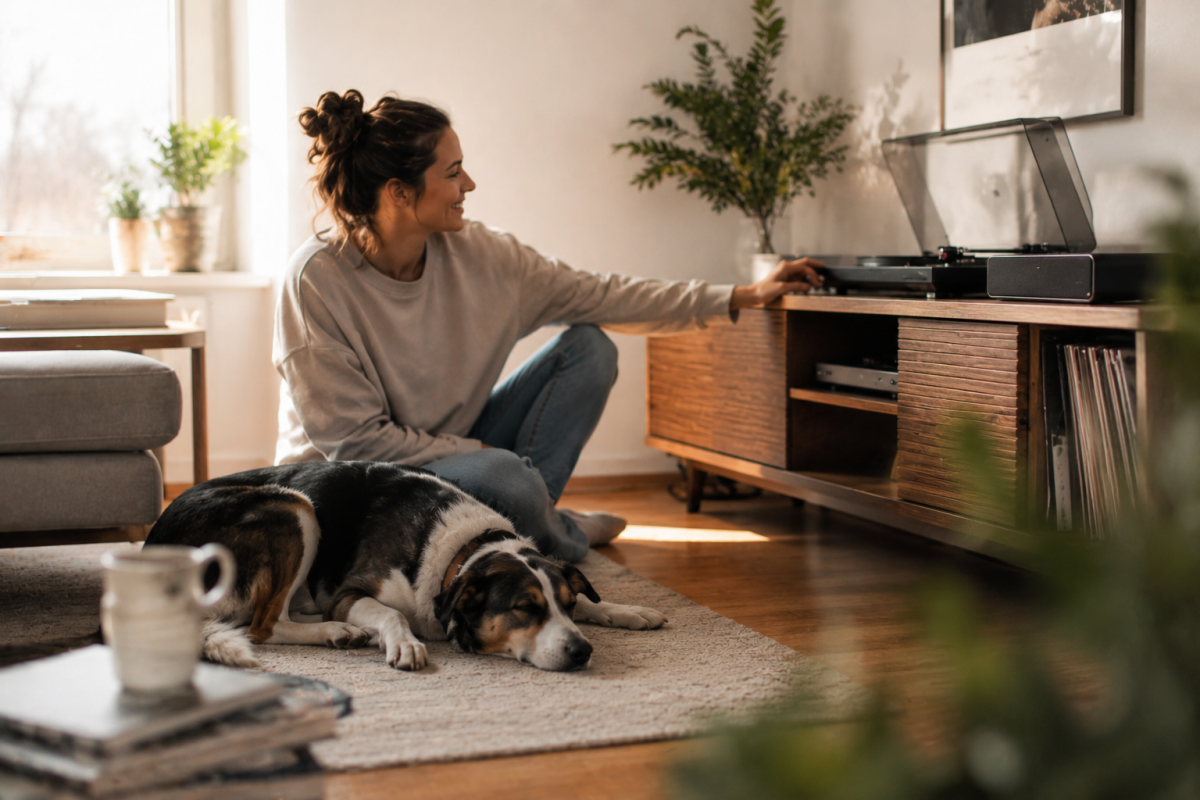
Spotify playlists: There are hundreds of public playlists created under terms like 'Dog Relax' or 'Calming Music for Dogs', composed mainly of soft piano pieces and regulated ambient music.
-
Audiovisual content on YouTube: You will find channels with long-duration videos (up to 8 or 10 hours) that combine relaxing frequencies with images of natural landscapes in soft tones, ideal for playing in the background on the living room TV.
-
Specialized applications: Native animal wellness apps that allow you to set timers, adjust the type of sound according to breed or age, and track the level of calm.
Tips to improve your dog's well-being with music
-
Combine it with mental stimulation tools: A perfect plan for when your dog is left alone is to play the music track and, at the same time, offer a frozen stuffed toy or a snuffle mat. The combination of cognitive stimulation with auditory relaxation is unbeatable.
-
Design a physical safety zone: Music is useless if the animal does not have a comfortable corner, protected from drafts, with its favorite bed and dim lighting that invites relaxation.
-
Be a good observer: Each individual is unique. Pay attention to their body language when you play a track: if they yawn, lie on their side, and sigh, you are on the right track; if instead they seem restless, perk up their ears, or move to another room, try a different type of sound or lower the volume. Their behavior will always be your best guide.
Related articles





Would you like the complete guide?
Leave your email address and we will send it to you in PDF format directly to your inbox. It's completely free!
By joining, you agree to subscribe to our newsletter to receive news, discounts, and special promotions from Grupo 4PATAS. You can unsubscribe at any time. See our Privacy Policy for more information.